English
 中文
中文What Factors Affect the Cost of Rigid Box Production?
 Sep 24,2026
Rigid box production costs are influenced by a combination of material, labor, equipment, and operational factors. Understanding these cost drivers helps buyers make more informed decisions about equipment, production planning, and process optimization in rigid box production. This article breaks down the key factors that affect production cost and explains how each one contributes to the total.
The Main Cost Categories
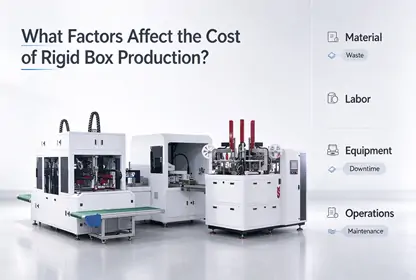
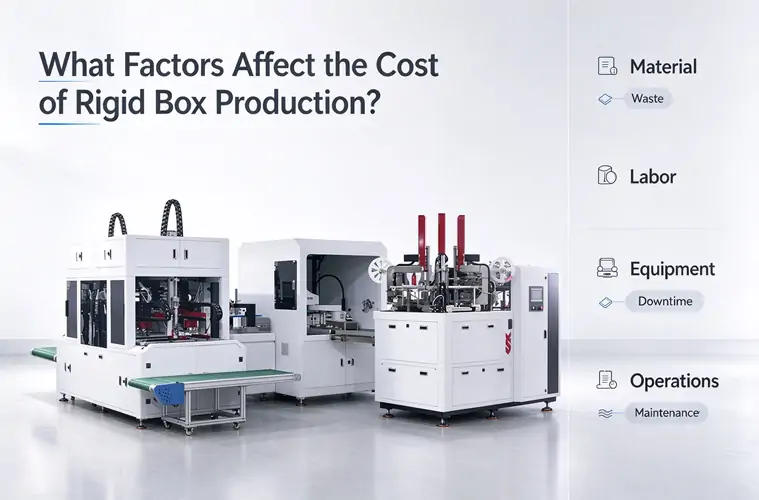
Production costs can be grouped into four broad categories:
- Material costs: Paper, board, adhesives, and decorative materials
- Labor costs: Operators, setup personnel, and quality inspectors
- Equipment costs: Purchase, installation, maintenance, and spare parts
- Operational costs: Energy, waste, downtime, and rework
Each category interacts with the others. For example, higher equipment automation may reduce labor costs but increase the initial investment. Understanding these trade-offs is essential for accurate cost planning.
Material Cost Factors
Material is typically the largest cost component in box production. Several factors influence how much material contributes to the total cost.
| Factor | Impact on Material Cost |
|---|---|
| Paper and board grade | Higher grades cost more but may reduce waste |
| Material thickness | Thicker materials increase cost per unit |
| Surface treatment | Coated or specialty finishes add cost |
| Adhesive type | Some adhesives are more expensive but may apply more efficiently |
| Material waste rate | Higher waste directly increases material cost per finished box |
Material waste is often overlooked. Waste can come from misalignment, wrinkling, glue errors, or improper cutting. Reducing waste through better equipment setup and process control can have a meaningful impact on overall cost.
Labor Cost Factors
Labor costs depend on production volume, automation level, and the skill required for each task. Key considerations include:
- Number of operators required per shift
- Skill level needed for setup and changeover
- Time required for quality inspection and rework
- Training and turnover costs
Fully automated equipment typically requires fewer operators but may need more skilled technicians for maintenance and troubleshooting. Semi-automatic equipment may require more operators but with lower skill requirements. The right balance depends on your production volume and local labor conditions.
Equipment Cost Factors
Equipment cost is not just the purchase price. It includes several components:
- Purchase price: Initial investment in the machine
- Installation and commissioning: Setup, testing, and training
- Maintenance and spare parts: Ongoing costs over the equipment's life
- Downtime cost: Lost production during breakdowns or changeovers
When evaluating equipment, consider the total cost of ownership rather than just the purchase price. A machine with a higher initial cost may be more economical over time if it reduces labor, waste, or downtime. For a closer look at how specific configurations are structured, review the available equipment options.
Operational Cost Factors
Daily operations also contribute to production cost. These factors include:
- Energy consumption: Electricity, compressed air, and heating or cooling
- Waste and rework: Materials lost to defects or setup errors
- Changeover time: Production time lost when switching between box types
- Production speed: Output per hour relative to labor and overhead costs
Changeover time is particularly important for factories producing multiple box types. Equipment with automatic mold adjustment and digital setup can reduce changeover time, helping maintain higher utilization rates. Regular maintenance services also help control operational costs by reducing unplanned downtime.
How to Estimate Production Cost
While actual costs depend on your specific production setup, a general estimation approach includes:
- Calculate material cost per box (including waste allowance)
- Estimate labor cost per box based on output rate and staffing
- Allocate equipment cost over expected production volume
- Add operational costs (energy, maintenance, overhead)
- Include a margin for rework and downtime
This approach provides a baseline for comparing different production scenarios. It can also help identify which cost areas have the greatest impact on total cost and where improvements may be most effective.
Common Cost Mistakes to Avoid
Buyers sometimes overlook factors that significantly affect long-term cost:
- Focusing only on purchase price: Ignoring maintenance, spare parts, and downtime costs
- Underestimating waste: Small waste rates add up over high production volumes
- Ignoring changeover time: Frequent changeovers can reduce effective production capacity
- Assuming labor costs are fixed: Automation may reduce labor but increase maintenance needs
Avoiding these mistakes requires a total-cost perspective and a clear understanding of your production requirements.
Conclusion
The cost of rigid box production is driven by material, labor, equipment, and operational factors. No single factor determines the total—it is the combination that matters. By understanding how each factor contributes, buyers can make more informed decisions about equipment, process design, and production planning.
For detailed technical guidance on equipment selection and cost considerations, contact our team to discuss your production requirements. You can also explore our application solutions for different box types and production scenarios.