English
 中文
中文Gift Boxes vs Phone Boxes vs Shoe Boxes: Production Differences
 Sep 30,2026
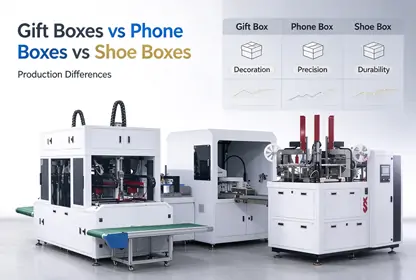
Not all boxes are produced the same way. Gift boxes, phone boxes, and shoe boxes differ in their material requirements, structural design, precision needs, and production volume expectations. Understanding these differences helps manufacturers select the right equipment, plan production efficiently, and avoid unnecessary adjustments in rigid box production. This article compares three common box types and outlines the key production considerations for each.
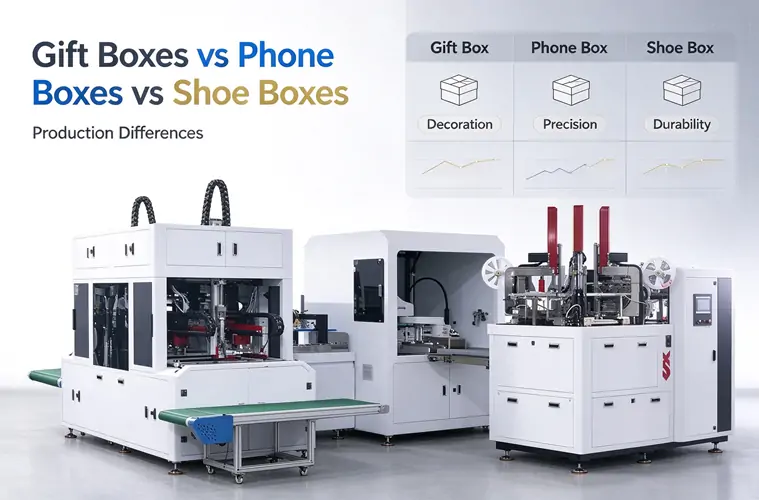
Why Box Type Matters in Production
The box type determines several critical production parameters:
- Material selection: Paper weight, board thickness, and surface finish
- Structural complexity: Number of pieces, folding requirements, and assembly steps
- Precision requirements: How tightly the box components must align
- Production volume: Batch size and changeover frequency
A production line optimized for one box type may not perform as expected on another without adjustments. Recognizing these differences early helps avoid costly trial-and-error.
Gift Boxes: Decoration and Presentation
Gift boxes are typically designed for visual impact. They often feature decorative surfaces, special finishes, and complex structures such as drawer boxes, magnetic closure boxes, or multi-piece assemblies.
Key production considerations:
- Surface quality is critical. Any wrinkle, glue mark, or misalignment is highly visible.
- Decorative materials such as textured paper, foil, or fabric require careful handling.
- Complex structures may require multiple forming and assembly steps.
- Precision alignment between the base and cover is essential for a premium appearance.
Equipment with visual positioning and gentle material handling is often preferred for gift box production. Because gift boxes are often produced in smaller batches with frequent design changes, changeover flexibility is also important.
Phone Boxes: Precision and Consistency
Phone boxes prioritize protection and brand presentation. They are typically smaller, rigid, and produced in very high volumes. Consistency between units is critical because even minor variations are noticeable at scale.
Key production considerations:
- Tight dimensional tolerances. The box must fit the product precisely.
- High production speed with minimal variation between units.
- Consistent glue application to avoid visible marks on often-minimalist designs.
- Clean edges and corners for a precise, high-quality appearance.
Phone box production typically benefits from fully automatic lines with high-speed positioning and forming capabilities. Because phone models change regularly, equipment that allows quick changeover between sizes is valuable.
Shoe Boxes: Durability and Volume
Shoe boxes are larger, more utilitarian, and produced in very high volumes. They must be durable enough to protect contents during shipping and handling while remaining cost-effective.
Key production considerations:
- Structural strength is a priority. The box must hold its shape under stacking and handling.
- Material cost is a major factor. Shoe boxes typically use more economical materials.
- High production speed with consistent quality across large batches.
- Simple, reliable construction with fewer decorative steps.
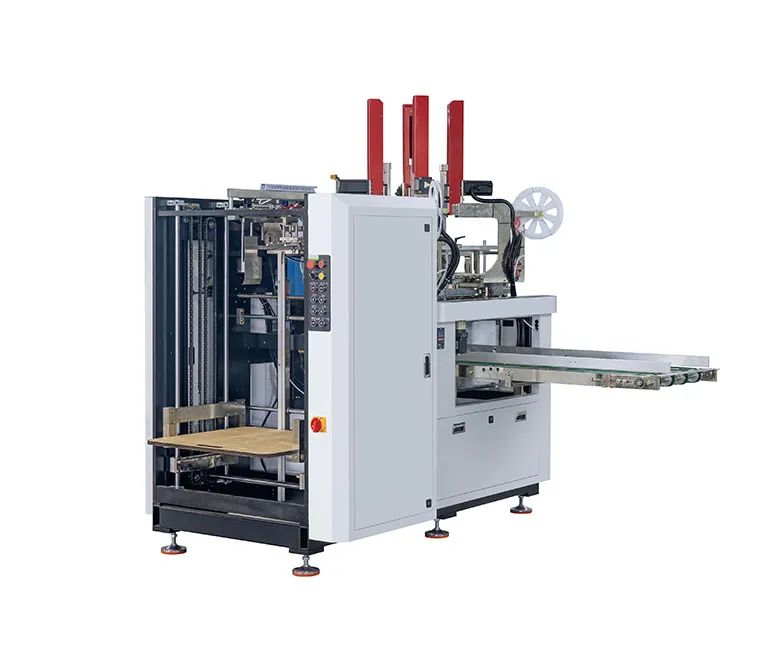
Shoe box production often uses equipment optimized for speed and durability rather than decorative precision. Because the box is larger, material handling and forming pressure must be adjusted accordingly.
Comparison Table: Production Considerations by Box Type
| Consideration | Gift Box | Phone Box | Shoe Box |
|---|---|---|---|
| Typical material | Decorative paper, specialty board | Rigid board, coated paper | Standard board, economical paper |
| Precision requirement | High | Very high | Moderate |
| Typical volume | Low to medium | High | Very high |
| Changeover frequency | Frequent | Moderate | Low |
| Key production challenge | Surface quality and alignment | Consistency at high speed | Structural strength and cost |
| Equipment preference | Flexible, precise | High-speed automatic | Durable, efficient |
Material and Equipment Adjustments
Switching between box types often requires adjustments to:
- Wrapping pressure and folding settings
- Glue application amount and pattern
- Positioning system calibration
- Material feed and handling mechanisms
Equipment with automatic or digital adjustment features can reduce the time and skill required for these changes. For operations producing multiple box types, this flexibility can significantly improve overall equipment utilization. To see how different configurations are structured, review the available equipment options.
What to Consider Before Production Planning
Before committing to a production plan for any box type, consider:
- What is the required annual volume for each box type?
- How often will production switch between types?
- What precision level does the product require?
- What materials will be used, and are they compatible with the equipment?
- What is the cost target per unit?
Answering these questions helps determine whether a single flexible line or multiple dedicated lines make more sense. Regular maintenance support also helps keep changeover times predictable and production consistent.
Conclusion
Gift boxes, phone boxes, and shoe boxes each have distinct production profiles. Gift boxes prioritize decoration and precision, phone boxes demand consistency at high speed, and shoe boxes focus on durability and cost efficiency. Understanding these differences helps manufacturers select appropriate equipment and plan production realistically.
If you produce multiple box types or are planning a new production line, contact our team to discuss your specific requirements. You can also explore our application solutions for different box types and production scenarios.