English
 中文
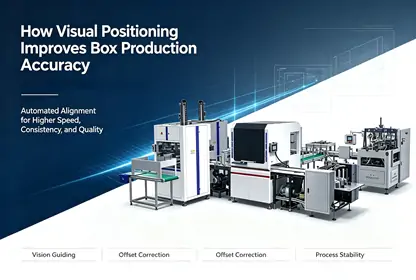
中文How Visual Positioning Systems Improve Accuracy in Box Production
 Sep 23,2026
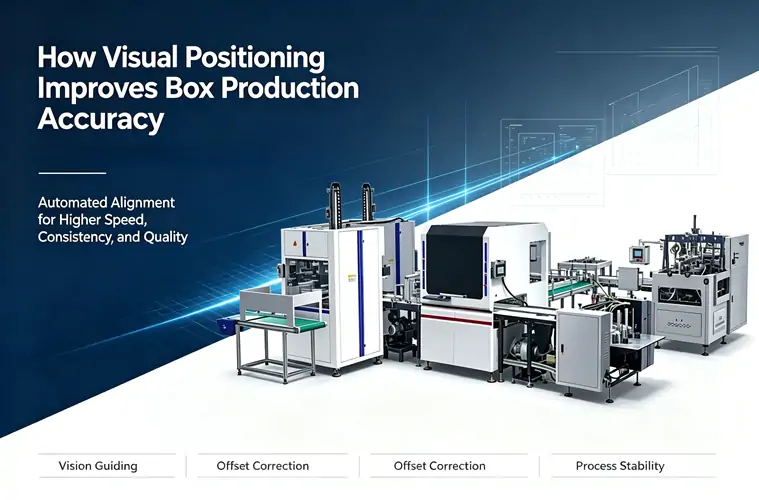
Visual positioning systems use cameras and sensors to detect the exact position of materials during production, then adjust the machine's movements to align with that position. This technology helps reduce registration errors, improve consistency, and support higher production speeds in rigid box production. This article explains how visual positioning works, what factors affect its accuracy, and what to consider when evaluating equipment with this capability.
What Is a Visual Positioning System?
A visual positioning system combines a camera, image processing software, and a motion control unit. The camera captures an image of the material or reference mark, the software calculates the offset between the current position and the target position, and the control system adjusts the machine accordingly.
Unlike mechanical positioning—which relies on physical guides and hard stops—visual positioning can compensate for small variations in material size, shape, or position. This makes it particularly useful when working with printed materials, textured surfaces, or pre-cut components. For an overview of equipment that incorporates this technology, review the available equipment options.
How Visual Positioning Works in Box Production
In box production, visual positioning is typically used at several stages:
- Wrapping and covering: The system aligns the face paper or cover material with the box core before wrapping.
- Gluing and folding: The system verifies that glue lines and fold lines are in the correct position.
- Assembly and finishing: The system checks alignment between the box base and cover.
The process generally follows these steps:
- The camera captures an image of the material or registration mark.
- The software compares the detected position to the expected position.
- The system calculates the necessary adjustment.
- The motion control unit moves the material or tool to the corrected position.
- The process repeats for each cycle.
Because this happens automatically, the system can maintain alignment even when material position varies slightly from piece to piece. For detailed technical specifications on how this is implemented in specific equipment, refer to the product specifications.
Factors That Affect Visual Positioning Accuracy
Several factors influence how accurately a visual positioning system performs.
| Factor | Impact on Accuracy |
|---|---|
| Camera resolution | Higher resolution allows detection of smaller features and finer adjustments |
| Lighting conditions | Consistent, controlled lighting improves image clarity and detection reliability |
| Material surface | Glossy, dark, or textured surfaces may require calibration or specialized lighting |
| Calibration frequency | Regular calibration maintains accuracy over time |
| Software algorithms | Advanced algorithms can handle more complex alignment tasks |
| Mechanical stability | Vibration or wear in moving parts can reduce positioning repeatability |
Understanding these factors helps operators set realistic expectations and maintain consistent performance.
Benefits of Visual Positioning in Production
When properly implemented and maintained, visual positioning offers several practical benefits:
- Reduced setup time: Operators can input new dimensions digitally rather than adjusting mechanical guides.
- Improved consistency: Automated alignment reduces variation between pieces.
- Better material handling: The system can work with materials that are difficult to position mechanically.
- Support for higher speeds: Because alignment is automatic, production speed is less limited by manual positioning.
- Reduced waste: Fewer misaligned pieces mean less rework and fewer rejected units.
These benefits depend on the specific application and how well the system is integrated into the production line.
Maintenance and Calibration Considerations
Like any precision system, visual positioning equipment requires regular attention to maintain accuracy. Key maintenance tasks include:
- Cleaning camera lenses and lighting components
- Checking and adjusting calibration targets
- Verifying software settings after material changes
- Inspecting mechanical components for wear or looseness
For equipment with visual positioning, these tasks should be part of the standard maintenance schedule. Regular maintenance services help ensure the system continues to perform as expected.
What to Consider When Evaluating Equipment
If you are considering equipment with visual positioning, ask the following questions:
- What materials and surface types has the system been tested with?
- How often does calibration need to be performed?
- What lighting conditions are required?
- How does the system handle material changes?
- What support is available for setup and ongoing maintenance?
Different systems have different capabilities and limitations. Confirming these details in advance helps ensure the equipment meets your production requirements. You can also explore application solutions to see how this technology is applied across different production scenarios.
Conclusion
Visual positioning systems provide a practical way to improve accuracy and consistency in box production. By automatically detecting and correcting material position, they help reduce errors that manual or mechanical positioning might miss.
When evaluating equipment with this technology, focus on how well the system matches your materials, production speed, and quality requirements. For more information on how visual positioning is applied in rigid box production, contact our team to discuss your specific application.