English
 中文
中文What Affects Positioning Accuracy in Automated Box Production Lines?
 Oct 13,2026
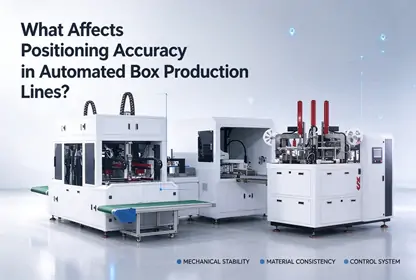
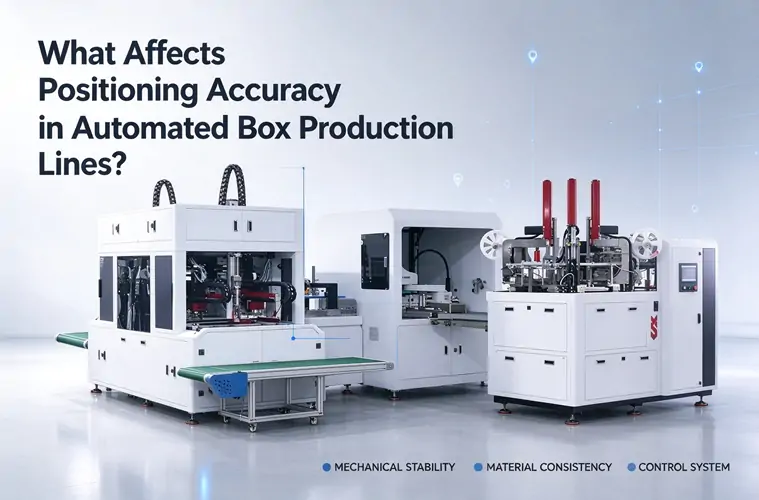
Positioning accuracy determines how precisely each component is placed during production. In rigid box making machine operations, alignment errors can lead to misaligned covers, uneven wrapping, and rejected units. Accuracy is not determined by a single component—it results from the interaction of mechanical stability, material consistency, control system performance, and environmental conditions. This article explains each factor and how it influences overall positioning results.
What Positioning Accuracy Means in Practice
Positioning accuracy refers to how closely the actual position of a material or component matches its intended position. In box production, this applies at multiple stages:
- Feeding: The material enters the machine at the correct position and angle
- Alignment: The face paper, board, or cover is positioned relative to the box core
- Forming: The wrapped or folded components maintain their intended alignment
- Assembly: The base and cover match within acceptable tolerances
Each stage depends on the previous one. A small error at feeding can become a larger error at assembly if not corrected.
Mechanical Factors
Mechanical stability is the foundation of positioning accuracy. Key mechanical factors include:
- Guide and rail condition: Worn or misaligned guides allow material to drift.
- Bearing and shaft wear: Play in rotating components introduces variation.
- Belt and chain tension: Loose drive components cause inconsistent movement.
- Frame rigidity: Vibration or flex in the machine frame affects repeatability.
- Clamp and gripper condition: Worn clamping surfaces may not hold material securely.
Mechanical issues tend to develop gradually, which makes regular inspection important. A machine that was accurate when new may drift over time if mechanical components are not maintained.
Material Factors
Material variation is one of the most common causes of positioning errors. Even small differences between sheets or batches can affect alignment:
- Thickness variation: Thicker or thinner material changes the effective position after clamping.
- Moisture content: Dimensional changes from moisture absorption affect registration.
- Surface friction: Slippery or rough surfaces behave differently during feeding.
- Warping or curling: Material that is not flat cannot be positioned accurately.
- Cut accuracy: Pre-cut components with dimensional errors cannot be aligned precisely.
Material consistency is largely a supplier and storage issue, but equipment settings can sometimes compensate for minor variation. Machines with automatic adjustment features can handle more material variability than fixed-setting machines.
Control System Factors
The control system determines how quickly and accurately the machine responds to positioning signals. Key factors include:
- Sensor accuracy: The precision of position detection directly limits achievable accuracy.
- Response time: Slower response to detected position errors reduces correction effectiveness.
- Servo tuning: Poorly tuned servos may overshoot or undershoot target positions.
- Software algorithms: The method used to calculate corrections affects final accuracy.
- Calibration frequency: Regular calibration maintains accuracy over time.
Modern automated lines typically use a combination of sensors, servo motors, and software to maintain alignment. The performance of these systems depends on proper configuration and ongoing maintenance. For detailed technical specifications on different equipment configurations, review the available options.
Environmental Factors
Environmental conditions can affect both materials and equipment:
- Temperature: Thermal expansion or contraction can change mechanical dimensions.
- Humidity: Affects material moisture content and, in some cases, lubrication properties.
- Vibration: External vibration from nearby equipment can reduce positioning repeatability.
- Dust and contamination: Particles on sensors or guides can cause detection errors.
For high-precision production, controlling the production environment may be necessary. At minimum, keeping the area clean and stable helps maintain consistent results.
How These Factors Interact
Positioning errors are rarely caused by a single factor. In practice, several factors combine:
- A slightly warped material may be positioned acceptably on a well-maintained machine but cause errors on a machine with worn guides.
- A correctly calibrated sensor may still produce errors if the material surface reflects light inconsistently.
- A stable control system cannot compensate for mechanical play that exceeds its correction range.
This is why troubleshooting positioning issues requires checking multiple factors rather than focusing on one.
Diagnostic Checklist for Positioning Issues
When alignment errors occur, work through the following checklist:
- Verify material dimensions, flatness, and moisture content
- Inspect guides, rails, and clamps for wear or misalignment
- Check belt and chain tension
- Confirm sensor calibration and cleanliness
- Review servo tuning and control parameters
- Check for external vibration sources
- Confirm environmental conditions are stable
- Run test samples and measure alignment accuracy
Documenting the results helps identify patterns and narrow down the root cause.
Maintenance Practices That Support Accuracy
Maintaining positioning accuracy requires ongoing attention. Practical measures include:
- Scheduled inspection of mechanical components
- Regular sensor and calibration checks
- Prompt replacement of worn parts
- Clean working environment
- Documented settings for each production run
Regular maintenance services help ensure these tasks are performed consistently and that small issues are addressed before they affect production quality.
Conclusion
Positioning accuracy in automated box production lines depends on mechanical stability, material consistency, control system performance, and environmental conditions. No single factor determines the result—it is the combination that matters. When alignment issues occur, a systematic diagnostic approach is more effective than adjusting one variable at a time.
If you are evaluating equipment or troubleshooting persistent alignment issues, contact our team to discuss your production requirements. You can also explore our application solutions for different box types and production scenarios.