English
 中文
中文Automatic Double Feeder Gluing Machine Maintenance: Daily, Weekly, and Monthly Tasks
 Jul 02,2026
An automatic double feeder gluing machine that applies adhesive unevenly, jams at the infeed, or requires constant roller adjustments does not have a design problem in most cases—it has a maintenance gap. Paper dust, dried glue residue, and worn feed belts accumulate gradually. By the time the operator notices inconsistent coating or misfeeds, the underlying issue has often been building for days or weeks. A structured maintenance programme prevents most of these problems from developing in the first place.
The tasks below cover the three main functional areas of the machine: the sheet feeding system, the glue application and circulation system, and the conveyor and delivery section. They apply to the Juxin JX‑GS650, JX‑GS850, and JX‑GS1050 models, which share a common design architecture—front‑edge suction feed, adjustable coating rollers, circulating glue with temperature control, and vacuum‑assisted conveyor.
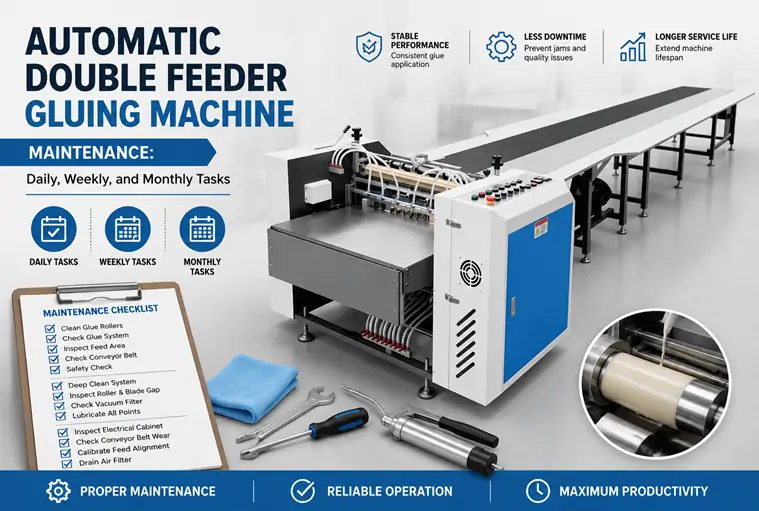
Daily Tasks (Every Shift)
1. Clean the glue rollers before the glue dries. At the end of every shift, or before any break longer than 30 minutes, the coating rollers must be cleaned. Dried glue on the roller surface hardens into a rough layer that disrupts the uniformity of the coating on the next run. The roller surface should be wiped with a damp cloth and warm water while the roller rotates at low speed. Solvents should only be used if they are specified for the glue type and compatible with the roller material. Abrasive pads or scrapers will damage the roller surface and create permanent low spots that produce uneven glue coverage.
2. Check the circulating glue system level and temperature. The glue reservoir should be topped up to the operating level at the start of each shift. The temperature controller should be set to the glue manufacturer's recommended application temperature—typically between 25 °C and 35 °C for water‑based adhesives. A glue that is too cold will be viscous and apply unevenly; too hot, and it may degrade or skin over in the tank. The operator should verify that the circulation pump is running and that glue is returning to the reservoir through the return line, indicating that the system is not blocked.
3. Inspect the sheet feed area for dust and debris. Paper dust and small paper fragments collect around the feed table, the front‑edge suction nozzles, and the infeed rollers. This debris can obstruct the suction ports and cause intermittent misfeeds. A quick vacuum or wipe with a dry cloth at the start and end of each shift keeps the feed path clear. The suction nozzle openings should be visually checked—any that appear blocked can be cleared with a soft brush or compressed air.
4. Check conveyor belt tracking and tension. The vacuum conveyor belt that carries sheets from the glue station to the delivery stack must run straight and at the correct tension. If the belt wanders to one side, the sheet edge can catch on the machine frame and cause a jam. A quick visual check at the beginning of the shift confirms that the belt is centred on its rollers and that there is no edge fraying.
5. Verify the emergency stop and safety guards. Every machine in daily production should have its safety circuit tested. Press the emergency stop, confirm that all drives stop immediately, and check that the safety guard interlocks are functioning. Any fault in the safety circuit must be repaired before the machine is returned to production. For an automatic double feeder gluing machine, the feed section guards are interlocked to prevent access while the machine is running.
Weekly Tasks
6. Deep‑clean the glue circulation system. Over a week of operation, glue residue accumulates in the tank, the pump impeller, the hoses, and the coating roller assembly. A weekly flush with warm water and a system‑compatible cleaning solution removes this build‑up before it hardens. The tank should be drained completely, flushed, refilled with cleaning solution, and the pump run until the return line shows clear liquid. Finally, the system is rinsed with clean water and refilled with fresh glue.
7. Inspect the coating roller and doctor blade gap. The gap between the coating roller and the doctor blade (or metering roller) determines the thickness of the glue film applied to the sheet. Over a week of operation, vibration and thermal expansion can shift this gap slightly. The gap should be checked with a feeler gauge at both ends of the roller and compared with the manufacturer's specification. An uneven gap produces a wedge‑shaped coating—thick on one edge and thin on the other—that can cause warping on the finished sheet.
8. Check the vacuum pump filter and suction lines. The vacuum pump that powers the conveyor belt suction and the sheet‑feed suction system pulls in paper dust with the air. The pump's intake filter accumulates this dust and should be cleaned or replaced weekly. The suction lines from the pump to the conveyor bed should also be checked for dust build‑up or condensation, particularly in humid environments.
9. Lubricate all grease points. The main drive chain, the roller bearings, the feed table ball bearings, and the conveyor drive bearings all require lubrication at weekly intervals during heavy production. The manufacturer's lubrication chart specifies the grease type and the number of shots per point. Over‑lubrication can push bearing seals out of position; a single shot from a calibrated grease gun per point is normally sufficient.
Monthly Tasks
10. Inspect and clean the electrical cabinet. The electrical cabinet houses the PLC, the motor drives, and the temperature controller. Paper dust can enter the cabinet through cable glands or ventilation grilles and settle on the electronic components, where it acts as thermal insulation and can cause overheating. The cabinet should be opened, cleaned with low‑pressure compressed air, and the ventilation filters replaced. All cable connections should be checked for tightness.
11. Check the conveyor belt for wear. The vacuum conveyor belt stretches slightly with use, and the belt surface can become glazed or develop cracks, particularly if it has been exposed to glue overspray. A belt that has lost its surface texture will not grip lightweight sheets reliably. The belt tension should be re‑measured and adjusted if necessary, and the belt should be replaced if cracking or glazing is found.
12. Calibrate the feed alignment. The sheet feed system relies on the front‑edge suction and the pressure rollers to deliver each sheet straight into the glue roller nip. If sheets are consistently feeding at a slight angle, the glue coverage will be uneven, and the sheet may skew on the conveyor. A monthly check involves running a batch of test sheets and measuring the squareness of the glue line relative to the sheet edge. If the glue line is not parallel, the feed alignment should be corrected according to the manufacturer's procedure. For a Juxin automatic double feeder gluer with adjustable feed table alignment, this correction typically involves adjusting the side lay and the pressure roller parallelism.
13. Drain the compressed air filter. The pneumatic systems on the machine—if equipped with pneumatic sheet separation or glue valve actuation—rely on dry, clean compressed air. Water in the air lines causes erratic pneumatic operation and can freeze in cold weather. The filter bowl should be drained monthly, and the filter element replaced quarterly.
Common Maintenance Mistakes
-
Cleaning the rollers with the wrong solvent. Solvents that attack the rubber or polyurethane roller cover cause swelling and softening. Only solvents recommended by the machine and glue manufacturer should be used.
-
Skipping the glue system flush because the machine is still producing acceptable quality. The build‑up is gradual, and by the time it affects quality, the system may need hours of cleaning rather than a quick flush.
-
Using any available grease. Mixing incompatible greases can cause the thickener to separate and the oil to run out, leaving bearings unprotected. The correct grease grade should be confirmed in the machine manual.
Building the Maintenance Programme
The tasks above should be compiled into a checklist that is kept with the machine. Each task should have a responsible person assigned, and the completed checklist should be reviewed by the production supervisor at the end of each week. The checklist should also record any parts replaced—roller bearings, belts, filters—so that a consumption history is built over time.
For operations running multiple machines or planning to add capacity, standardising the maintenance programme across all gluers reduces the training burden and ensures that spare parts such as rollers, belts, and filter elements can be stocked for the entire line. The Juxin JX‑GS series gluing machines share a common maintenance approach across all three models, which simplifies this standardisation.
A gluing machine that receives consistent, documented maintenance delivers repeatable glue coverage, feeds sheets reliably, and avoids the unplanned stoppages that disrupt packaging and printing production schedules. The daily, weekly, and monthly tasks above address the components that most commonly cause quality issues and downtime. When the maintenance programme is followed, the machine holds its settings, produces cleanly glued sheets, and operates with minimal intervention shift after shift.