English
 中文
中文What Causes Defects in Rigid Box Production?
 Aug 05,2026
Wrinkles on wrapped surfaces, misaligned covers, uneven glue application, and weak corner joints are among the most common quality issues in rigid box production. These defects typically stem from three root causes: material inconsistencies, improper machine settings, and insufficient process control. Understanding these causes is the first step toward prevention. This article examines the most frequent rigid box production defects, explains why they occur, and outlines how automated equipment features can help minimize them.
Common Rigid Box Defects and Their Root Causes
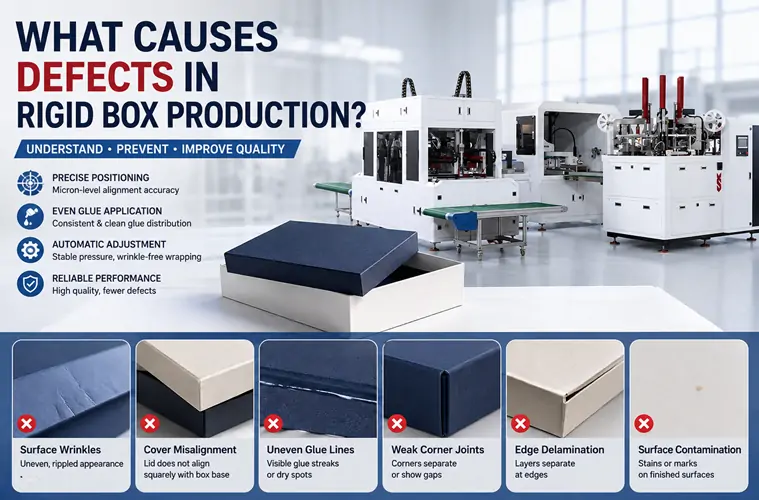
Rigid box production involves multiple processes—wrapping, gluing, positioning, folding, and corner pasting—each of which can introduce quality issues if not properly controlled. The table below summarizes the most common defects, their typical causes, and the production stages where they occur.
| Defect Type | Typical Appearance | Common Causes | Affected Process |
|---|---|---|---|
| Surface wrinkles | Uneven, rippled appearance on box surfaces | Inconsistent material tension; improper wrapping pressure; uneven glue distribution | Wrapping / Gluing |
| Cover misalignment | Lid does not align squarely with box base | Inaccurate positioning; registration errors; material warping | Positioning / Folding |
| Uneven glue lines | Visible glue streaks or dry spots on face paper | Inconsistent glue application; incorrect glue viscosity; clogged nozzles | Gluing |
| Weak corner joints | Corners separate or show gaps | Insufficient corner pasting pressure; incorrect adhesive amount | Corner pasting |
| Edge delamination | Layers separate at edges | Insufficient pressure during folding; glue not properly activated | Folding |
| Surface contamination | Stains or marks on finished surfaces | Excess glue transfer; unclean rollers; material handling issues | Multiple stages |
Material-Related Defects
The quality of raw materials directly affects rigid box making equipment performance and output quality. As noted in JUXIN Machinery's technical documentation, raw material quality control is an important factor in determining the thickness and strength of the carton.
Paper Quality Issues
Face paper that is too thin, has inconsistent moisture content, or contains impurities can lead to wrinkles during the wrapping process. Similarly, paperboard with uneven thickness may cause the box to warp after forming. Buyers should verify that their materials meet the equipment's specified paper weight and thickness ranges.
Adhesive Compatibility
Not all adhesives work equally well with all paper types. Using an adhesive with the wrong viscosity can result in uneven application—too thick and it won't spread evenly; too thin and it may soak through the paper. The gluing area and overall distribution of glue on the face paper must be carefully monitored, as uneven gluing can directly lead to box quality problems.
Material Storage Conditions
Paper and paperboard are hygroscopic—they absorb moisture from the air. Storing materials in environments with fluctuating humidity can cause dimensional changes, leading to misalignment during positioning and folding. Ideally, materials should be stored in climate-controlled conditions and allowed to acclimate to the production environment before use.
Machine Setting-Related Defects
Even with high-quality materials, incorrect machine settings can produce defective boxes. The following issues are among the most frequently encountered.
Wrapping Pressure and Tension
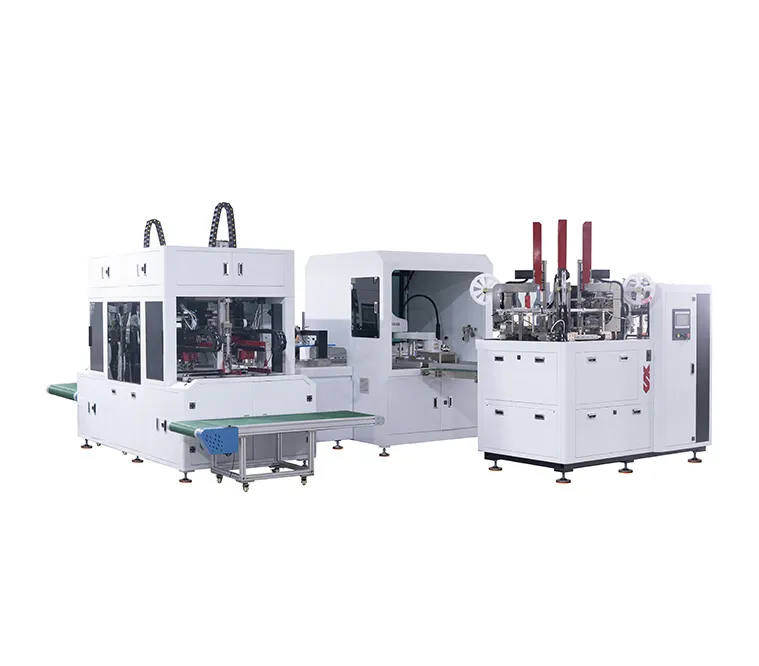
In the wrapping process, inconsistent pressure or tension is a primary cause of surface wrinkles. Modern rigid box wrapping machines address this by allowing operators to input the desired product size, after which the machine automatically adjusts the mold with precision. This automated adjustment reduces the risk of human error in pressure setting.
However, operators should still verify that the material is loaded correctly and that tension settings are appropriate for the specific paper type being used.
Positioning Accuracy
Misalignment between the box cover and base often traces back to positioning errors. Advanced visual positioning technology can achieve micron-level positioning accuracy, significantly improving production efficiency and product quality. Systems that use intelligent visual technology with robotic arms can provide better performance in material alignment.
Glue Application Consistency
Uneven glue application is one of the most common and preventable defects. The glue must be applied uniformly across the entire gluing area. Issues can arise from:
- Incorrect glue viscosity
- Clogged or worn applicator nozzles
- Inconsistent feed rates
- Improper roller settings
Regular inspection and cleaning of the gluing system components are essential to maintain consistent application.
Process Control and Operator Factors
Beyond materials and machine settings, production process control plays a critical role in defect prevention. When configuring application solutions, it is essential to account for both material variability and operator proficiency.
Setup and Changeover
When switching between different box sizes or materials, proper setup is essential. Machines that require manual changing of pressure plates or blades during operation introduce more opportunities for error. Equipment designed with mold-free operation—where adjustments are made through digital inputs rather than physical part changes—can significantly reduce setup-related defects.
Production Speed
Running a production line too fast can compromise quality, particularly in the gluing and folding stages. The optimal production speed depends on the specific materials being used and the complexity of the box design. Operators should establish speed parameters that balance throughput with quality requirements, and adjust them when material or design changes occur.
Quality Monitoring
Implementing regular quality checks throughout the production process—not just at the end—allows for early detection and correction of issues. Visual inspection stations, either manual or automated, can help identify defects before they result in large quantities of rejected product.
How Automated Equipment Features Help Prevent Defects
Modern rigid box production equipment incorporates several features designed to minimize common defects. To review the full product lineup, visit the main products page.
| Equipment Feature | How It Helps Prevent Defects |
|---|---|
| Automatic mold adjustment | Eliminates errors from manual pressure plate changes; ensures consistent wrapping pressure |
| Intelligent visual positioning | Achieves micron-level alignment accuracy; reduces misalignment defects |
| PLC servo control systems | Provides precise, repeatable motion control; minimizes variation |
| Integrated gluing and positioning | Combines operations to reduce handling errors and improve registration |
| Thirteen-servo forming systems | Ensures boxes are formed in perfect condition through multi-point control |
These features, combined with regular maintenance services, significantly reduce the variability that leads to defects and extend the reliable lifespan of your production line.
Quality Inspection Checklist for Rigid Box Production
Before starting a production run—and periodically during production—operators should verify the following:
- Material verification: Paper thickness, moisture content, and surface quality meet specifications
- Glue preparation: Adhesive viscosity is correct; applicator system is clean and functioning
- Machine setup: Size parameters are correctly entered; mold adjustment is complete
- Test run: Run 5-10 sample boxes and inspect for wrinkles, alignment, and glue consistency
- Pressure settings: Wrapping and folding pressures are appropriate for the material
- Positioning calibration: Visual positioning system is calibrated for the current box size
- Corner pasting: Corner joints are secure with no gaps or excess glue
- Final inspection: Check finished boxes for surface quality, edge integrity, and dimensional accuracy
Frequently Asked Questions
Q: What is the most common cause of wrinkles in rigid box wrapping?
A: The most common cause is inconsistent pressure or tension during the wrapping process. This can result from incorrect machine settings, variations in material thickness, or uneven glue application. Using a machine with automatic mold adjustment can help maintain consistent pressure across different production runs.
Q: How does material quality affect rigid box production?
A: Material quality is a primary factor in determining box thickness and strength. Poor-quality paper or paperboard can lead to wrinkles, warping, and structural weakness. Even with a well-calibrated machine, substandard materials will produce substandard boxes.
Q: Can gift boxes and mooncake boxes be produced on automated rigid box equipment?
A: Yes. Currently, the production of gift boxes, wine boxes, and mooncake boxes on the market can be handled by rigid box production equipment. Manufacturers are also exploring and developing equipment for shaped boxes to meet diverse process requirements.
Q: What should I check first when boxes come out misaligned?
A: First, verify that the positioning system is correctly calibrated for the current box size. Check that materials are loaded straight and that there is no warping. Also confirm that the gluing process is not causing the paper to shift before positioning.
Q: How often should the gluing system be cleaned?
A: Cleaning frequency depends on the type of adhesive used and production volume. As a general rule, the gluing system should be inspected daily and cleaned whenever a different adhesive is used or when glue application becomes inconsistent. Regular cleaning prevents clogged nozzles and ensures uniform glue distribution.
Q: Can I use the same machine settings for different box sizes?
A: No. Different box sizes and materials require different settings for wrapping pressure, positioning, and folding. Machines with automatic adjustment capabilities allow operators to input new dimensions, after which the machine recalibrates automatically. This reduces setup time and minimizes errors compared to manual adjustment.
Conclusion
Defects in rigid box production—whether wrinkles, misalignment, glue issues, or weak corners—are rarely caused by a single factor. More often, they result from interactions between material quality, machine settings, and process control. The most effective approach to defect prevention combines:
- Selecting appropriate materials that meet the equipment's specifications
- Proper machine setup with careful attention to pressure, positioning, and glue application
- Regular quality monitoring throughout the production process
- Leveraging automation features that reduce variability and human error
If you are experiencing persistent quality issues, start by reviewing your material specifications and verifying that your machine settings are appropriate for the current production run. For detailed technical guidance and tailored support, contact our technical team to discuss specific adjustments. You can also explore additional application resources via our solutions section.