English
 中文
中文Full Automatic Rigid Box Production Speed: Understanding Rated vs Actual Output
 Jul 24,2026
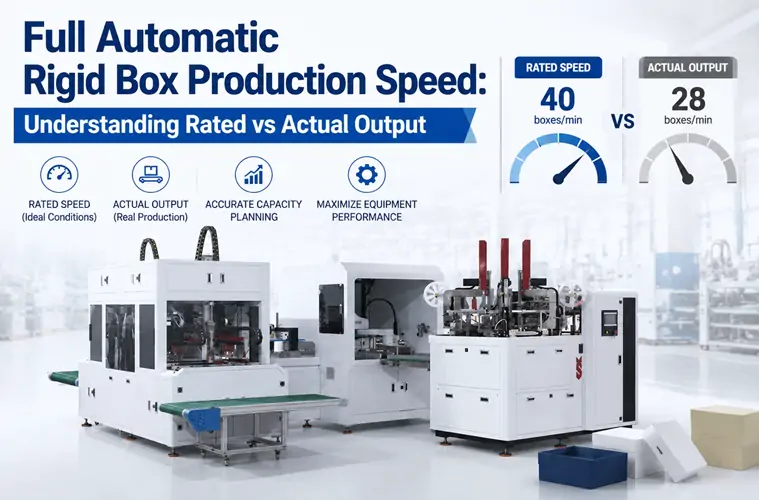
Every packaging equipment buyer encounters the same discrepancy: the machine's rated speed in the specification sheet says 40 boxes per minute, but the daily production report shows output closer to 28. The gap is not a sign that the equipment is underperforming or that the specification was misleading. It reflects the difference between two different measurement concepts—rated speed and actual output—and understanding what separates them is the key to accurate capacity planning.
Rated speed describes what the machine achieves under ideal conditions: running a single box size, with consistent materials, no interruptions, and no changeovers. Actual output describes what the machine delivers in a real production environment: multiple box sizes, varying material quality, scheduled stops for glue replenishment, and the inevitable minor adjustments that accumulate across a shift. This guide explains what drives the gap between these two numbers and how to build a realistic production forecast for an automatic rigid box making line.
What Rated Speed Actually Measures
Rated speed is a laboratory measurement. The manufacturer runs the machine under controlled conditions with materials selected for consistency—uniform grey board thickness, flat printed paper with minimal curl, adhesive at optimal viscosity. The machine runs a single box size without any changeovers. Under these conditions, the machine can achieve its maximum cycle rate because every variable is optimized.
The rated speed is useful for comparing machines from different manufacturers because it provides a common reference point. A machine rated at 40 boxes per minute is mechanically capable of cycling at that rate. What the rated speed does not tell you is how many of those cycles will produce acceptable boxes across an entire shift, or how many minutes per day the machine will actually be cycling versus being set up, cleaned, or adjusted.
What Eats Into Actual Output
Actual output is rated speed minus the accumulation of every pause, adjustment, and interruption that occurs during a normal production shift. These interruptions fall into several categories:
Changeover time. Switching from one box size to another requires adjusting the forming station, repositioning the gluing system, changing the wrapping die, and recalibrating the visual positioning system. These adjustments can take anywhere from 10 minutes for a simple size change on a well-designed machine to over an hour for a complete format change involving different box styles. A line producing three different box sizes per shift loses a significant portion of its available production time to changeovers.
Material variation. Grey board thickness varies between batches. Printed paper curl changes with humidity. Adhesive viscosity shifts with ambient temperature. The machine's sensors and servos compensate for these variations to maintain consistent quality, but the compensation often requires the machine to slow down slightly. When materials are at the edge of the machine's specified tolerance range, the slowdown is more pronounced.
Scheduled stops. Glue reservoirs need refilling. Wrapping film rolls need replacing. Quality checks require taking samples from the line. Each of these stops may be brief, but across a shift they add up. A line that stops for three minutes every half hour loses 48 minutes of production time over an eight-hour shift—that is 10% of the available time.
Box size and complexity. Rated speed is typically established with a mid-range box size that the machine handles most efficiently. Very small boxes or very large boxes run slower because the material handling dynamics are different. A machine rated at 40 boxes per minute for a standard 200×150×50mm box may run at 30 per minute for a 400×300×80mm box and 35 per minute for a 100×80×30mm box. Operations that produce a mix of sizes should factor these differences into their overall output calculations.
How to Calculate Realistic Daily Output
A practical formula for estimating daily output starts with the rated speed and applies a series of reductions:
Step 1: Determine net running time. Subtract changeover time from total shift time. If a shift runs 480 minutes and two 30-minute changeovers occur, net running time is 420 minutes.
Step 2: Subtract scheduled stop time. Account for glue refills, film changes, quality sampling, and operator breaks. A typical allowance is 10 to 15 percent of net running time, depending on how automated these functions are.
Step 3: Apply the speed efficiency factor. This factor accounts for the machine running below rated speed due to material variation, box size effects, and minor adjustments. For consistent materials and mid-range box sizes, this factor may be 85 to 95 percent. For operations with frequent size changes or variable material quality, the factor may drop to 70 to 85 percent.
Step 4: Apply the quality efficiency factor. Not every cycle produces a saleable box. Some boxes will be rejected at quality inspection due to misalignment, adhesive defects, or wrapping flaws. A well-tuned line with skilled operators may achieve 97 to 99 percent quality efficiency. A line running difficult materials or new box designs may see 90 to 95 percent.
The result of multiplying these factors against the rated speed gives a realistic daily output estimate. A machine rated at 40 boxes per minute, with 420 minutes net running time, 90 percent speed efficiency, and 97 percent quality efficiency, produces approximately 14,666 boxes per shift. That is about 36 boxes per minute of actual output across the full shift—considerably less than the rated 40.
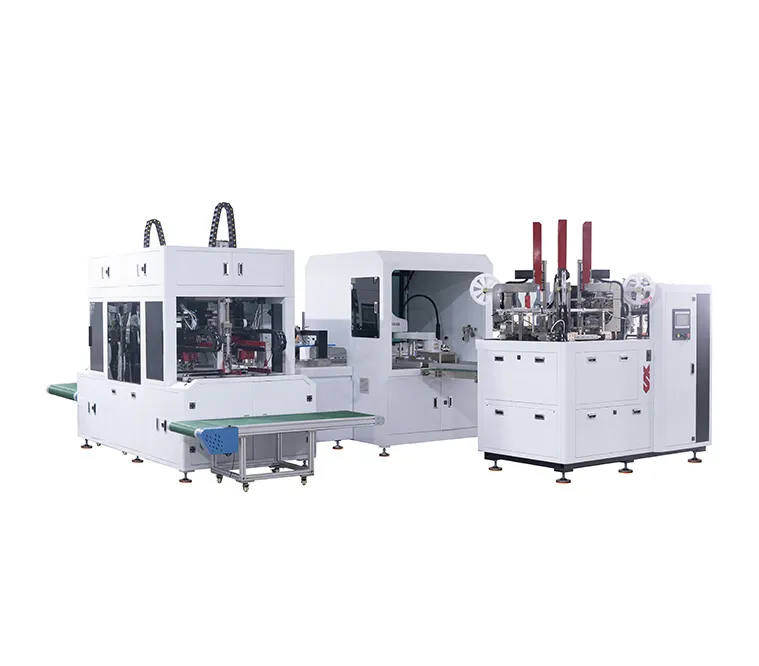
For operations comparing different equipment options, requesting rigid box production line specifications that include cycle time data for multiple box sizes and formats allows a more accurate production forecast to be built during the evaluation phase.
Why Understanding the Gap Matters
The difference between rated speed and actual output is not a problem to be eliminated. It is a reality of every production environment, and it should be factored into capacity planning from the beginning. A packaging converter who budgets for 40 boxes per minute and buys a machine rated at that speed, only to discover that actual output is closer to 30, has miscalculated their production capacity by over 30 percent. The consequences cascade: missed delivery deadlines, overtime labor costs, or the need to purchase additional equipment sooner than planned.
An accurate understanding of actual output allows the business to quote realistic lead times, schedule production efficiently, and make informed decisions about when additional capacity is needed. When evaluating machines, requesting that automated box making equipment suppliers provide estimated cycle times for your specific box range—rather than relying on the headline rated speed—produces a more useful basis for comparison.
Disclaimer
The speed calculations and efficiency factors discussed in this article are for informational purposes based on general industry experience. Actual output varies depending on machine configuration, box size and style, material characteristics, operator skill, and facility conditions. Manufacturers should be consulted for speed estimates specific to a given product mix, and production forecasts should be validated through on-site testing with actual materials before finalizing capacity plans.